Nothing takes you forward like going backwards.
With our standard equipment — perception, memory — it is often by retracing our steps that we begin to see the path.
Because no one really knows where they are going while they are going there.
The artist, perhaps more than anyone, tends to dive in headfirst. They venture into the unknown. They invent their own reality. People often say: their world. “The artist is lost in their own world.” I don’t like that. It sounds dismissive. I prefer the word reality. Reality is serious. Even when an artist imitates the reality already in place, they recreate it.
And when you cut a new path through reality, you don’t see the path right away.
You struggle through the jungle, cut through vines, tend to snake bites, sweat through fevers, sometimes walk in circles.
In 2026, if I refresh my personal history, I inevitably come to this question: when did technology enter my work?
I was born in 1973. Son of a boomer.
I grew up without the Internet, without mobile phones, without social media, and without algorithms deciding what I would see.
And yet, around the age of 23, I began inventing a language.
I wasn’t thinking about technology.
I simply needed a vocabulary that could take me where words couldn’t go.
A few years later, another intuition appeared.
Maybe there was something shamanic in what I was looking for.
I had read The Cosmic Serpent by Jeremy Narby.
The idea that you could explore an invisible world and bring something back from it spoke to me.
Then came 2009.
That year, I had the idea of using my lines to make self-portraits.
With an intuition: by moving beyond the concept — speaking with lines — and searching within my own inner states, I might discover things that were still invisible to me.
And genuinely artistic.
I knew the systems of Sol LeWitt, Morellet and Molnar.
But I was looking for something else: using rules not to control the form, but to search for something within myself.
But how do you make a self-portrait without drawing a face, using only lines?
You have to start somewhere.
I need a center.
So I draw a quadrilateral. A line closing in on itself.
I call it the “milieu d’origine” — the environment we come from, but also, literally, the place of origin.
The idea and the name came from a friend who had told me about Pierre Bourdieu and the importance of social background in shaping an individual.
I like that idea.
My drawing begins at the center, but that center is already an origin.
From there, I give myself instructions.
Do this.
Then that.
Don’t go outside.
Start from the center.
Build.
I experiment.
I change some rules.
I keep others.
At the time, I don’t have the word “algorithm” in mind.
I am simply looking for a way to let my state at that particular moment enter a structure solid enough to keep me from getting lost.
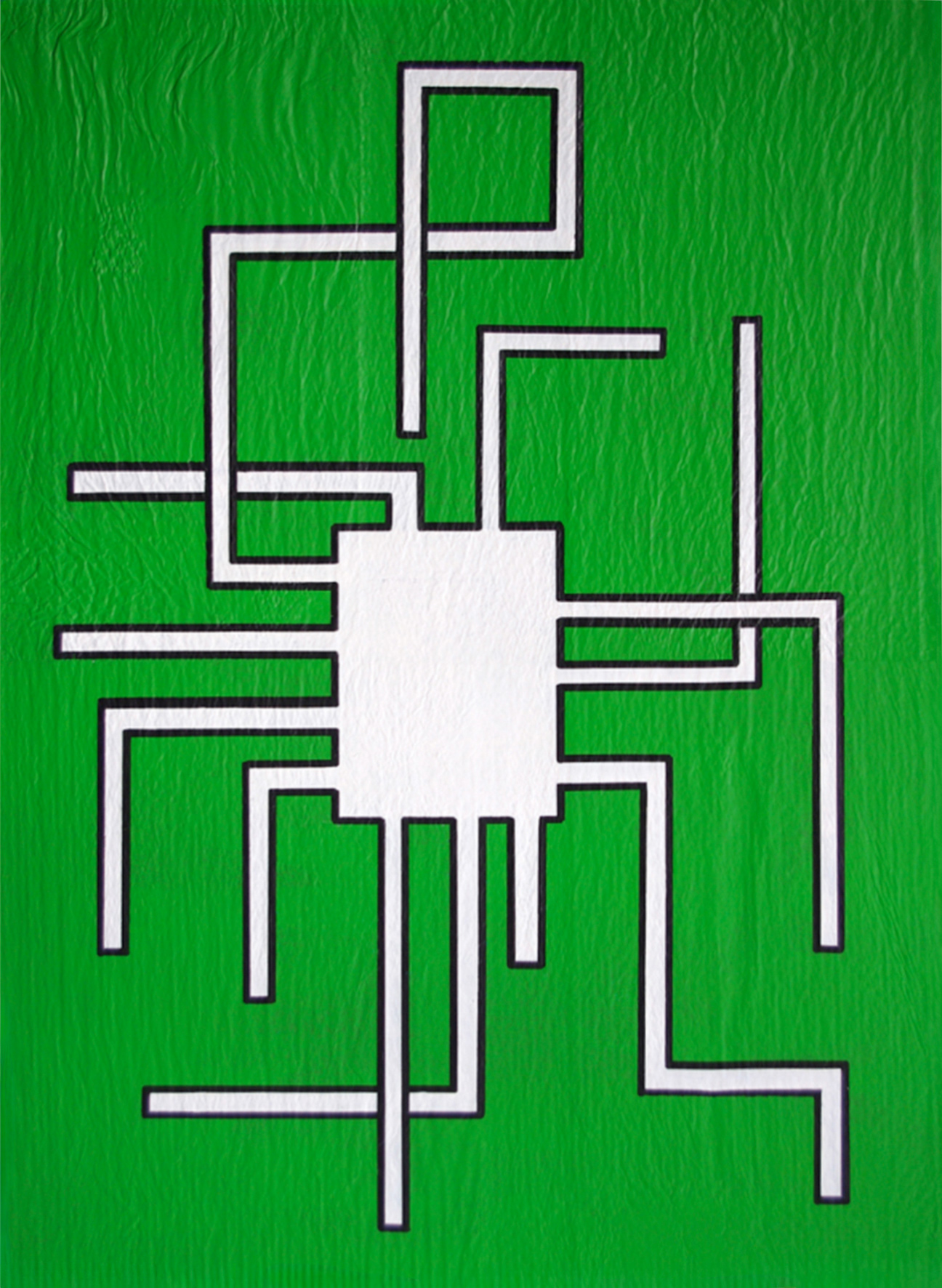
Self-Portrait 09.06, 2009
In 2010, I exhibit these drawings for the first time.
I call them Self-Portraits.
That same year, I read Transhumain by Bruce Benderson.
And something connects.
I begin to understand that what I am doing might also have something to do with technology.
A language.
Instructions.
A program.
A human being executing it.
On one side, The Cosmic Serpent.
On the other, Transhumain.
The shaman and the machine.
I am somewhere between the two.
But there is something I didn’t know.
I have only just discovered it by going back through my history.
At the same time I begin my Self-Portraits, Facebook is also developing systems that use the traces left by its users to determine what they will see.
What we like.
Who we interact with.
What we look at.
What we click on.
Funny coincidence.
At the same time, Facebook and I are both using systems of rules to search for something about individuals.
But we are looking in opposite directions.
Their algorithm starts from our external traces and tries to understand who we are.
Mine starts from my inner state and turns it into a geometric trace.
Facebook observes what we do.
I record what I am experiencing.
And there is another difference.
Their algorithm tries to predict.
Mine has no idea what it will find.
That is precisely why I built it.
To search for the unpredictable and the uncertainty curled up inside my body, at the very moment when everything around us is increasingly trying to calculate, anticipate, predict.
I thought I was just making self-portraits.
Looking back, I realize I built a strange machine that took me far beyond that idea — towards the invisible, spirituality, but also technology, philosophy…
A kind of techno-shamanism, in the end.
For fifteen years, I have been conducting this experiment in which I am simultaneously the programmer, the subject and the instrument.
The more Self-Portraits I accumulate, the less certain I am that I know who I am.
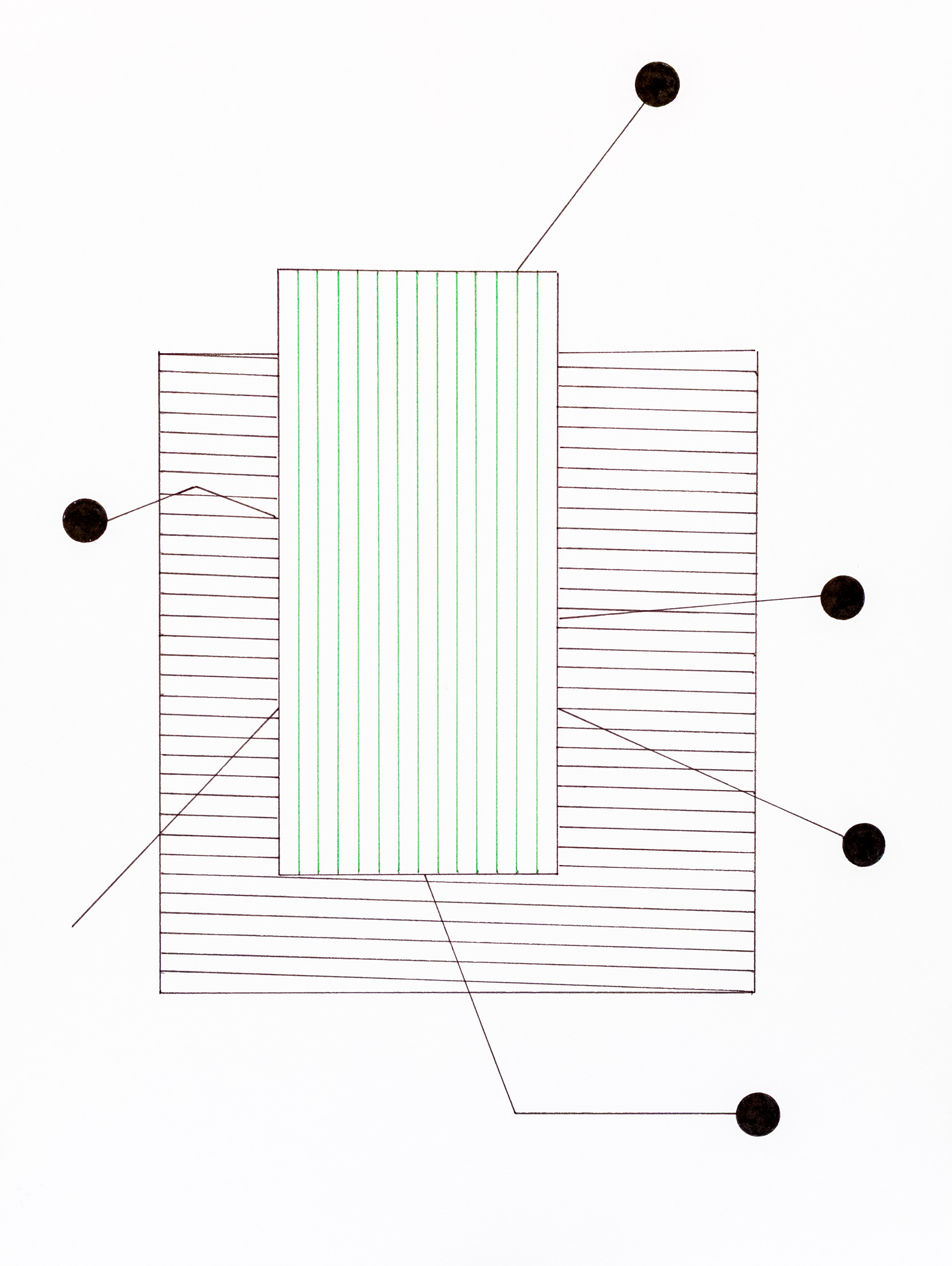
Self-Portrait 26.93, 2026
We make paths without really seeing where they lead, sometimes without even realizing they are paths.
It is only by going back through our history that we can sometimes begin to understand something.
Uncertainty, the unconscious, circumstances, sometimes the absurdity of the search — they form something like our dark matter.
We know almost nothing in advance.
And now we would like AI to help us find our way.
But that’s a hell of a joke.
AI is made in our image. It is our mirror.
It can help us search, understand, compare, remember what others have thought before us.
But it cannot know in our place what we are looking for.
Our dark matter is as invisible to AI as it is to us.
So between an algorithm trying to predict my desires and my desires taking me somewhere without knowing where, I would still rather get lost with my own.
A path is not the purpose of an existence.
The only known destination is death.
The path is what remains once it has been walked.